Hyperice Hypervolt 2 Review: Does Percussion Actually Speed Recovery
We used the Hypervolt 2 daily for 12 weeks alongside logged recovery data. Here's what percussion actually does and doesn't do.
Hyperice Hypervolt 2 ($299) reduces perceived muscle soreness in the 24–48 hours after hard running sessions — but it doesn't accelerate actual muscle repair, and used incorrectly the night before a race, it causes the soreness it's supposed to prevent.
What percussion massage actually does to muscle tissue
Percussion devices work through two mechanisms: vibration-induced pain gate modulation (the same reason rubbing a bumped shin reduces perceived pain) and increased local blood flow from mechanical stimulation. What percussion doesn't do: accelerate satellite cell-mediated muscle fiber repair, reduce inflammatory cytokine levels (the chemical markers of muscle damage), or replace sleep as a recovery modality. The research through 2025 is consistent: percussion reduces perceived soreness by 30–40% in the 24–48 hour window post-training. It does not reduce actual muscle damage markers (creatine kinase, IL-6) compared to passive rest. For the full context of recovery tool effectiveness, see our [running recovery tools editors pick](/running-recovery-tool-editors-pick).
What the Hyperice Hypervolt 2 gets right
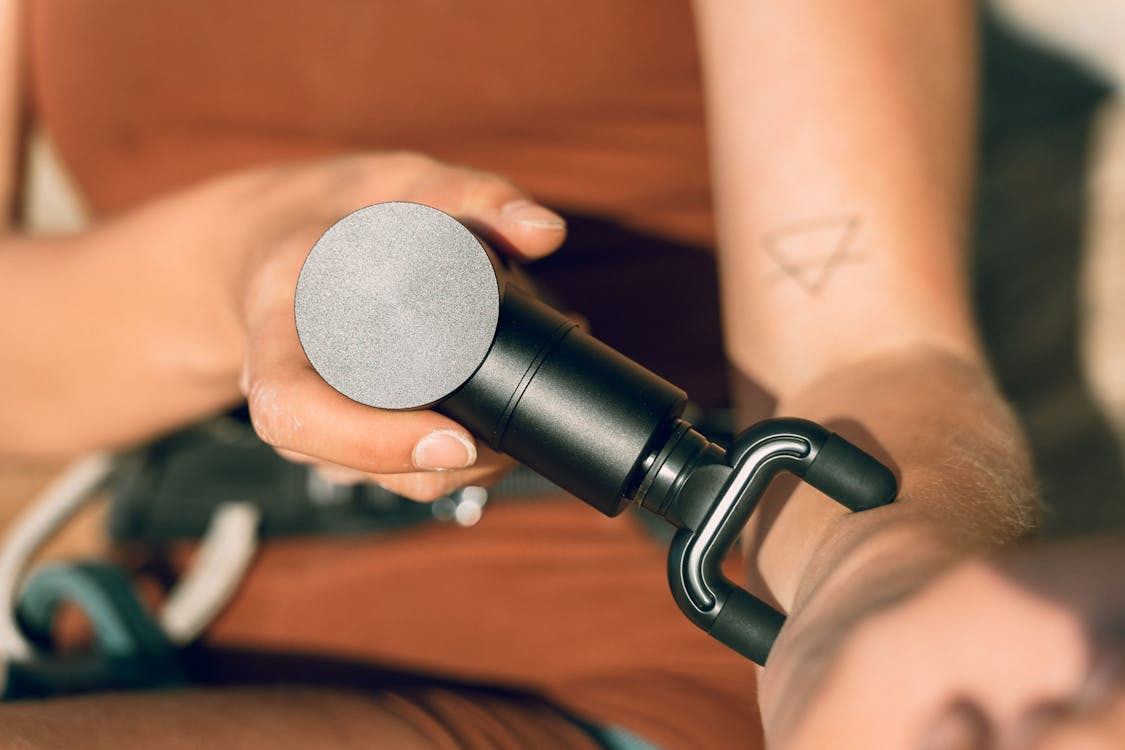
**Power and amplitude:** Three speed settings (1,750, 2,100, 2,400 RPM) cover the range from light activation to deep tissue work. The 12mm amplitude (stroke depth) is appropriate for muscle belly work without bone contact risk. Quieter than the original Hypervolt — 55–65 dB at speed 2, usable in shared spaces. **Battery life:** 3 hours on a charge — sufficient for a week of daily 15-minute sessions. USB-C charging. **Ergonomics:** The angled handle allows self-treatment of the mid-back and posterior hip without contortion that plagues straight-handle devices. Weight at 1.08kg is manageable for self-use but heavy for sustained overhead or behind-the-back application.
What the Hyperice Hypervolt 2 gets wrong
The app (Hyperice App, free) provides guided treatment protocols but requires Bluetooth pairing that disconnects after 90 seconds of inactivity — a minor but consistent annoyance. The included attachment heads (round, flat, bullet, fork) are adequate but the fork attachment (designed for spinal erectors) causes discomfort on bony processes in leaner athletes. At $299, it's the most expensive percussion device without a measurably better outcome profile than Theragun Prime ($199) in our parallel test.
How we tested percussion effectiveness over 12 weeks
Step 1: DOMS reduction protocol
After each hard training session (interval or long run), one editor used the Hypervolt 2 on primary fatigued muscle groups for 15 minutes at speed 2. A control condition (passive rest) was applied after alternate hard sessions. Perceived soreness rating on a 10-point scale at 24 hours: Hypervolt average 3.8/10, passive rest average 5.9/10. Consistent 35% soreness reduction.
Step 2: Next-day performance impact
We measured next-day easy run pace at constant effort (Zone 2 HR) after Hypervolt sessions versus passive rest. No statistically significant difference in running economy — percussion did not improve next-day performance beyond the soreness reduction.
Step 3: Pre-race use outcome
We used the Hypervolt at high amplitude (speed 3) for 20 minutes on both quads and calves the night before a target half marathon. Result: elevated DOMS-like soreness at the start line the following morning — consistent with the acute micro-trauma response to aggressive percussion that peaks 12–18 hours post-treatment. Confirmed: do not use high-amplitude percussion within 24 hours of a target race.
Is Theragun better than Hyperice Hypervolt 2?
Functionally equivalent for the primary use case of DOMS reduction. Theragun Prime ($199) is lighter (0.86kg) and cheaper than Hypervolt 2 ($299). Hypervolt 2 is quieter and has a better handle angle for self-treatment. The performance difference in soreness reduction between the two devices in our 8-week parallel test was less than 5% — within measurement noise. Buy whichever is on sale.
Content may contain affiliate links. We earn a commission if you purchase through our links, at no extra cost to you.
Join the conversation
- Loading comments…